Market Report ·
Δ Σ Φ | DeltaNode Trading Position & Risk Transparency Report
How DeltaNode manages real market exposure through hedging, liquidity analysis, position sizing, and disciplined risk management.
DeltaNode Trading Position & Risk Transparency Report
8 October 2026
Overview
At DeltaNode, we believe market analysis should be connected to real risk management.
A market view is easy to publish after a move has already happened. The more important question is how exposure is managed while uncertainty is still present.
This report documents our current trading approach, including the use of short positions, hedges, cross-margin exposure, stop-loss levels and liquidity management.
The purpose is not to present a winning trade or promote a particular position.
The purpose is transparency.
Current Positioning
Our current crypto exposure includes a combination of:
- Short positions across selected altcoins
- Hedged exposure
- Cross-margin positions
- Positions with predefined stop-loss levels
- Positions that can offset risk elsewhere in the portfolio
The portfolio should therefore not be interpreted simply by looking at the number of long or short positions.
The relevant question is:
What is the portfolio's net exposure after the positions interact with each other?
A short position can be directional. Another position can function as a hedge. A third position can provide exposure to a different market regime.
This is why DeltaNode evaluates the portfolio as a system rather than treating every trade independently.
Position Disclosure
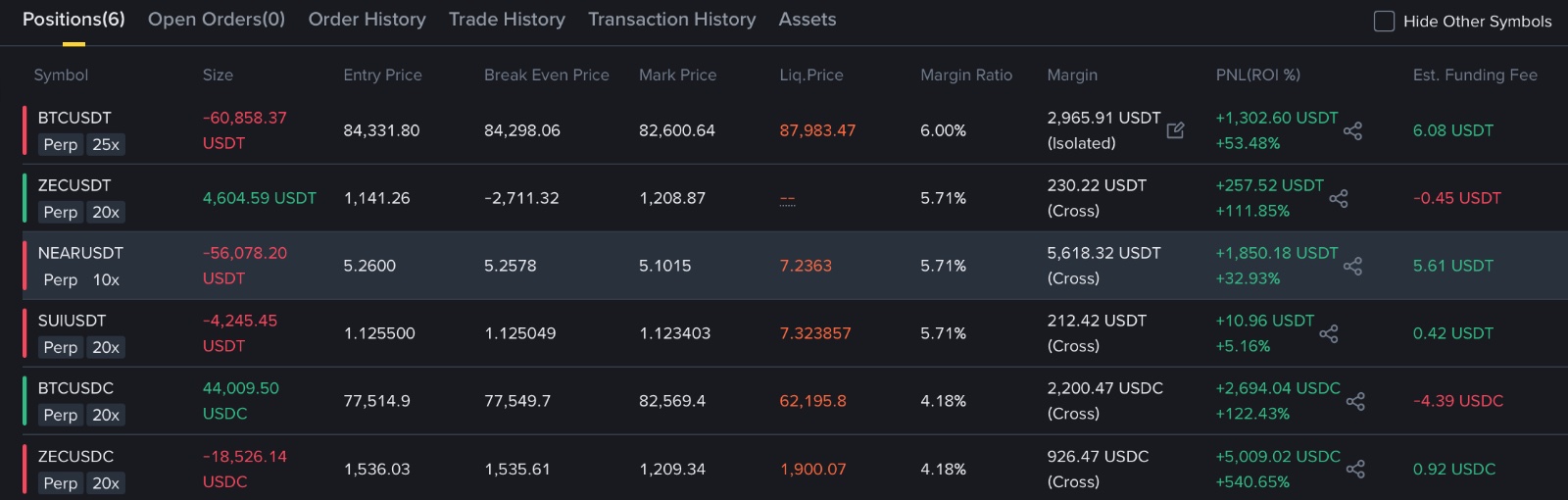
To demonstrate the difference between analysis and actual execution, we may publish snapshots of current positions.
Where appropriate, these screenshots can include:
- Asset
- Long or short direction
- Entry price
- Current price
- Stop-loss
- Unrealized P&L
- Position status
- Hedge structure
Certain account information may be intentionally obscured, including:
- Total account balance
- Wallet addresses
- Account identifiers
- Sensitive exchange information
- Information that could compromise account security
The objective is to provide meaningful transparency without unnecessarily exposing the trading account itself.
P&L Transparency
When a position screenshot is published, the displayed P&L represents the position at that specific point in time.
Unrealized profit is not the same as realized profit.
A position showing a positive P&L can subsequently become negative or be closed at a different result. Likewise, a temporary loss does not necessarily represent the final outcome of a position that remains open.
For this reason, DeltaNode does not use a single profitable screenshot as evidence of trading performance.
A snapshot is evidence of positioning, not proof of a long-term return.
We believe this distinction is important.
Why We Use Hedging
Markets do not always provide clean directional signals.
There are periods where:
- Price is rising while derivatives positioning deteriorates
- Open interest increases without confirming spot demand
- CVD shows selling pressure
- Funding becomes crowded
- Liquidity becomes fragmented
- Macro conditions conflict with short-term price action
In these situations, forcing a single directional position can create unnecessary risk.
Hedging allows exposure to be managed while the market structure develops.
The objective is not to eliminate risk completely.
The objective is to control the type and size of risk being taken.
Cross-Margin Exposure
Cross-margin can allow positions to share available margin across a portfolio.
This can be useful when positions are deliberately structured to offset one another.
However, cross-margin also introduces additional risk because losses in one position can affect available margin elsewhere.
For that reason, cross-margin should never be interpreted as automatically safer than isolated positions.
Its usefulness depends on:
- Position sizing
- Correlation
- Liquidity
- Leverage
- Stop-loss discipline
- Portfolio construction
- Market volatility
DeltaNode therefore treats margin structure as part of the overall risk model rather than as an independent trading strategy.
Stop-Loss & Invalidation
A stop-loss represents a predefined risk boundary.
It answers a simple question:
At what point is the original thesis no longer worth defending?
This is different from trying to predict the exact top or bottom of a market.
A disciplined trader should be prepared to accept that a thesis can be wrong.
Our approach therefore focuses on:
Thesis → Position → Invalidation → Risk → Review
rather than:
Prediction → Hope → Bigger Position
The objective is to make risk visible before the trade becomes emotional.
Liquidity Is Critical
Liquidity is one of the most important variables in derivatives markets.
A position can appear manageable under normal conditions but become significantly more difficult to close or hedge when liquidity disappears.
DeltaNode therefore pays attention to:
- Market depth
- Trading volume
- Open interest
- Funding rates
- CVD
- Taker activity
- Liquidation levels
- Spot/perpetual divergence
- Volatility
- Market concentration
When liquidity is strong, execution can generally be more efficient.
When liquidity deteriorates, slippage and liquidation risk can increase rapidly.
This is particularly important for smaller altcoins, where a seemingly small position can represent significant exposure relative to available market liquidity.
Reading Open Interest and CVD Together
Open interest and CVD are not interpreted independently.
For example:
OI ↑ + CVD ↓ + Funding positive
can indicate that positions are being added while aggressive selling is occurring and longs are paying funding.
That does not automatically mean price must fall.
It means the positioning deserves closer attention.
Likewise:
OI ↓ + CVD ↓
may indicate deleveraging rather than fresh short building.
This distinction matters because the same price movement can come from very different underlying positioning.
DeltaNode therefore attempts to interpret derivatives data as market structure, rather than turning individual metrics into automatic buy or sell signals.
Portfolio-Level Risk
One of the most common mistakes in leveraged trading is evaluating every position independently.
Five apparently small positions can collectively create a large directional exposure if they are highly correlated.
For example, several altcoin shorts may appear diversified but can effectively represent one large bet on the broader crypto market.
This is why portfolio-level exposure matters.
We monitor:
Directional exposure
Correlation
Leverage
Liquidity
Margin usage
Hedge effectiveness
Maximum acceptable loss
A portfolio is only diversified if its risks are actually different.
What the Published Screenshot Represents
If a current position screenshot accompanies this report, it should be understood as a time-stamped disclosure of positioning.
It is not:
- A guaranteed trade signal
- A recommendation to copy the trade
- Proof of future performance
- A claim that every position will be profitable
- A representation of realized returns
It is simply evidence of how exposure was structured at that moment.
If the positions are profitable at the time of publication, that will be visible.
If they are losing, that should also remain visible.
Transparency only has value when the outcome is not selectively presented.
Why We Are Publishing This
DeltaNode is being built as a market-intelligence and trading-analysis system.
We want the platform to be evaluated on the quality of its process, not on isolated screenshots of successful trades.
Publishing both analysis and real positioning helps demonstrate the relationship between:
Market data
↓
Market structure
↓
Risk assessment
↓
Position construction
↓
Hedging
↓
Risk management
↓
Outcome
The outcome can be positive or negative.
The process is what should remain consistent.
No-Trade Is Also a Position
One of the most important conclusions from market analysis is sometimes that there is no attractive trade.
When liquidity is poor, macro conditions are unclear, derivatives positioning is crowded or multiple signals conflict, reducing exposure can be more rational than forcing a position.
A trading system should therefore be capable of saying:
NO TRADE
without treating that as a failure.
Capital preservation is part of the strategy.
Transparency Standard
Going forward, DeltaNode's public trading-related disclosures should follow several principles:
1. Time-stamped
Every position snapshot should indicate when it was captured.
2. No selective winners
Profitable positions should not be presented without acknowledging losing or closed positions where relevant.
3. No guaranteed returns
Historical or unrealized P&L should never be presented as a promise of future performance.
4. Risk before reward
Position size, leverage, liquidity and invalidation are more important than displaying a green P&L number.
5. No blind copying
A published position is contextual information, not an instruction to replicate the trade.
6. Security first
Sensitive account information should never be exposed simply for the sake of transparency.
Conclusion
DeltaNode's approach is not based on being permanently bullish or bearish.
Markets change.
Liquidity changes.
Positioning changes.
Macro conditions change.
The goal is therefore to maintain a framework that can adapt without losing control of risk.
Our current positions include shorts, hedges and cross-margin exposure because the portfolio is being managed around risk, liquidity and market structure, rather than a single directional prediction.
A profitable screenshot is easy to publish.
A disciplined process is harder.
That process is what DeltaNode intends to make visible.
Important Disclosure
DeltaNode provides market intelligence, analytical tools and trading-related information for informational and educational purposes.
Nothing in this report should be interpreted as financial advice, an offer to buy or sell any asset, or a guarantee of future performance.
Trading cryptocurrencies and derivatives involves substantial risk, including the possibility of losing part or all of the capital committed. Leveraged trading can amplify both gains and losses.
Any position shown in an accompanying screenshot represents a specific portfolio at a specific point in time and may change without notice.
Past performance and unrealized P&L are not indicative of future results.