Market Report ·
🇺🇸 US STOCKS & CRYPTO MARKET REPORT Monday 12th October , 2026
Bitcoin is trading around $83,000, recovering modestly from Friday’s low near $82,600. However, the broader crypto picture remains mixed. Spot Bitcoin ETFs experienced substantial net outflows during the first week of October, Ethereum ETFs extended their losing streak, and market sentiment remains fragile despite a rebound in prices.
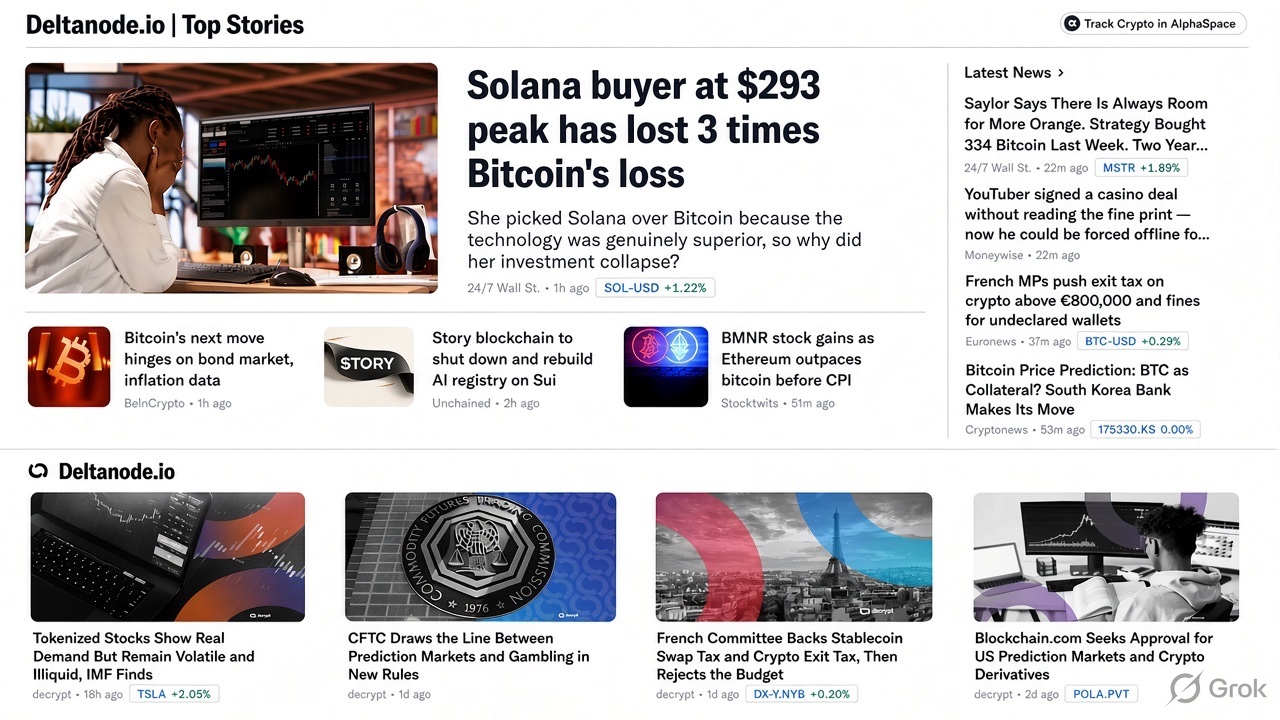
🌐 DeltaNode Market Intelligence
ΔΣΦ | Monday, 12 October 2026
Bitcoin, Oil Shock, Inflation Risk & Global Market Positioning
📌 Executive Summary
Bitcoin is trading around $83,000, recovering modestly from Friday’s low near $82,600. However, the broader crypto picture remains mixed. Spot Bitcoin ETFs experienced substantial net outflows during the first week of October, Ethereum ETFs extended their losing streak, and market sentiment remains fragile despite a rebound in prices.
The dominant macro driver is the escalating geopolitical risk across the Middle East. Reported Houthi attacks targeting Saudi Arabia and renewed threats to regional shipping have pushed Brent crude above $105 per barrel. Although the United States announced a temporary arrangement allowing Russian diesel exports, the initial price relief faded within hours as supply-security concerns returned.
The next major macro catalyst is Wednesday’s US CPI report. Forecasts point to a sharp increase in headline inflation, driven largely by energy prices, while core inflation is expected to moderate. The distinction matters: an energy-led increase may be temporary, but persistent core inflation could keep monetary policy restrictive and pressure risk assets.
Meanwhile, South Korea’s equity market suffered a sharp decline following a technology-sector sell-off, with foreign investors selling heavily. Two significant crypto-security developments also deserve attention: a reported hardware implant found in a Ledger device purchased through a reseller, and a critical XRP Ledger arithmetic vulnerability that reportedly could have enabled unintended XRP creation.
The DeltaNode takeaway: This is a market where price recovery alone is insufficient confirmation. We need to monitor ETF flows, spot demand, derivatives positioning, dollar strength, Treasury yields, oil, and Wednesday’s inflation data before committing to a directional thesis.
₿ 1. Bitcoin Market Structure
Reported market snapshot
- Bitcoin: $83,343 | +0.45% over 24 hours
- Ethereum: $2,546 | +1.88%
- Total crypto market capitalization: $2.82 trillion | +0.73%
- 24-hour trading volume: $65.76 billion | +60.35%
- Bitcoin dominance: 59.34% | -0.18%
- Crypto Fear & Greed Index: 57, Neutral
- Altcoin Season Index: 64/100
These are the supplied snapshot figures, not independently refreshed live quotes.
What happened?
Bitcoin recovered slightly over the weekend after touching approximately $82,600 on Friday. The move suggests short-term stabilization, but it does not yet establish a durable bullish reversal.
US spot Bitcoin ETFs reportedly recorded approximately $386.3 million in net outflows during the first seven trading days of October. October 7 alone accounted for $484.9 million in reported outflows, indicating that the period's aggregate selling was partly offset by inflows on other sessions.
Ethereum ETF flows were also weak, with approximately $697.4 million in cumulative outflows since September 29 and nine consecutive losing sessions reported.
Despite the pressure, both BTC and ETH remained near their weekly highs. This divergence between price resilience and fund flows is important: it may indicate that other buyers are absorbing ETF-related selling, but it could also mean that price support is vulnerable if demand weakens further.
DeltaNode interpretation
Bullish evidence
- BTC recovered from the Friday low.
- ETH outperformed BTC over the reported 24-hour period.
- Aggregate crypto capitalization and trading volume increased.
Bearish or cautionary evidence
- Sustained ETF outflows weaken the institutional-demand picture.
- Geopolitical escalation could increase volatility across risk assets.
- Rising volume is not inherently bullish; it must be assessed alongside spot CVD, price structure, and derivatives positioning.
What would strengthen the bullish case?
- BTC holds its recovery structure rather than immediately revisiting the Friday low.
- Spot CVD turns positive and remains supportive.
- ETF flows stabilize or return to positive territory.
- Open interest increases alongside genuine spot buying rather than leveraged chasing.
- The dollar and Treasury yields stop moving higher.
What would weaken it?
- BTC loses the Friday low with expanding sell volume.
- Spot CVD remains negative while open interest rises.
- ETF outflows persist alongside weakening spot demand.
- Oil-driven inflation concerns push yields and the dollar higher.
No single indicator should determine the trade. The relationship between price, spot demand, open interest, funding, and liquidity matters more than any isolated reading.
🏦 2. ETF Flows and Institutional Demand
The first week of October delivered a warning about institutional crypto demand.
Bitcoin ETFs
- Reported cumulative net outflows: $386.3 million
- Largest reported daily outflow: $484.9 million on October 7
- Friday inflow reported in the accompanying market briefing: $21.1 million
The Friday inflow suggests that selling pressure may have moderated, but one positive session does not reverse a broader outflow trend.
Ethereum ETFs
- Reported cumulative outflows: $697.4 million since September 29
- Reported losing streak: nine consecutive sessions
Why this matters
ETF flows provide a useful measure of demand through regulated investment products, but they are not a complete measure of the crypto market. Investors can buy directly on exchanges, through other products, or via different investment vehicles.
A price recovery during ETF outflows can have several explanations:
- Non-ETF buyers are absorbing supply.
- Short covering is lifting prices.
- Derivatives activity is temporarily supporting the market.
- Sellers are becoming less aggressive.
We need additional order-flow and positioning data to distinguish between these explanations.
DeltaNode watch: Track daily ETF flows against BTC price, spot CVD, exchange liquidity, and open interest. A sustained price recovery accompanied by renewed inflows and positive spot demand would provide stronger confirmation than price alone.
🔐 3. Crypto Security: Ledger Hardware Implant
A significant hardware-wallet security story emerged over the weekend.
According to the supplied report, Ledger confirmed on Saturday that a device purchased through reseller CryptoBilis contained an unauthorized hardware implant. CryptoBilis reportedly suspended hardware-wallet sales while investigating.
This is materially different from a conventional phishing incident: a physical implant raises the possibility that a device may have been tampered with before reaching its buyer.
What should affected users do?
If a device has not been initialized:
- Do not initialize it or enter an existing recovery phrase.
- Stop using the device until its provenance has been verified.
- Contact the manufacturer and reseller through independently verified official channels.
If a device was purchased through the affected reseller and already initialized:
- Treat the situation seriously and obtain guidance from the manufacturer using independently verified contact details.
- If the device or seed phrase may be compromised, use a trusted, verified wallet setup to create a genuinely new recovery phrase and transfer assets to addresses controlled by that new wallet.
- Never enter the old recovery phrase into an untrusted website, support chat, or replacement device of uncertain provenance.
A replacement device is not sufficient protection if the old recovery phrase is reused. The security objective is to establish a new, uncompromised signing environment and recovery phrase.
Important: The reported incident does not establish that all Ledger devices are compromised. The specific reseller, device provenance, and manufacturer's investigation matter.
🧮 4. XRP Ledger: Critical Arithmetic Vulnerability
Researchers reportedly identified a decade-old integer-overflow vulnerability in the XRP Ledger's payment engine.
The reported flaw involved crafted payments routed through mispriced offers. Under vulnerable conditions, arithmetic overflow could potentially bypass supply-related protections and enable unintended creation of spendable XRP.
The report states that:
- The vulnerability had existed for approximately a decade.
- Exploitation could reportedly be triggered with only a few hundred XRP.
- Two existing safeguards were reportedly bypassed.
- A fix was released on September 25.
- The patch reportedly bypassed the normal validator-voting process because of the severity.
Why an integer overflow matters
Computers represent numbers within defined numerical limits. If an arithmetic operation exceeds those limits and the software handles the result incorrectly, a calculation may wrap around or produce an invalid value.
In financial software, this can undermine assumptions about balances, payments, or total token supply.
An invariant check is designed to ensure that fundamental rules remain true after a transaction. For example, a ledger may verify that assets have not appeared without authorization. An invariant can fail to catch a vulnerability if it relies on the same flawed calculation, checks the wrong representation of a value, or does not cover the relevant execution path.
The exact reason the XRP Ledger's invariant reportedly failed requires the technical postmortem or vulnerability disclosure; the supplied summary alone does not establish which mechanism was responsible.
DeltaNode security lesson
Critical financial infrastructure must be tested beyond normal transaction flows. Integer-boundary tests, checked arithmetic, fuzzing, independent invariant checks, formal verification where appropriate, and supply monitoring are important defenses.
A patch can prevent future exploitation, but it cannot automatically reverse assets created through a successful exploit. Any actual supply impact must be established from the official technical disclosure and ledger data.
🏢 5. Strategy and Michael Saylor: Potential Bitcoin Purchase
Michael Saylor posted, “There's always room for more orange” on Sunday, a phrase widely interpreted as a hint that Strategy may announce another Bitcoin purchase.
The supplied report places Strategy's confirmed holdings at approximately 848,000 BTC, around 2,000 BTC short of 850,000, following four weekly purchases since late August.
However, a new purchase has not been confirmed in the supplied information. The post is a signal to watch, not proof of an executed transaction.
Why the market watches Strategy
Strategy's purchases can influence market sentiment because they demonstrate demand from a major corporate Bitcoin holder. Yet the market impact depends on the size and funding of each purchase, the price paid, broader liquidity, and whether the announcement was already anticipated.
A headline purchase does not guarantee an immediate rally, particularly when ETF flows are negative.
The supplied material also raises the question of how Strategy's market net asset value (mNAV) premium compressed between 2024 and mid-2026, but it does not provide the relevant historical figures. That comparison should not be quantified without a reliable valuation series.
DeltaNode watch: Look for an official holdings disclosure, the confirmed amount acquired, purchase funding details, and BTC's price reaction after the announcement.
🛢️ 6. Oil Shock: Geopolitical Risk Returns to the Foreground
Oil is currently one of the most important macro variables in the market.
The supplied reports describe Houthi missile attacks targeting Riyadh's King Khalid International Airport, continued regional military escalation, and separate maritime incidents near Oman and the Strait of Hormuz.
The briefing reports that the airport remained closed, Lufthansa suspended Riyadh flights until October 16, and a projectile and a drone affected commercial shipping in the region. It also reports that the Houthis declared Saudi airspace a zone of military operations.
The reported human toll is severe: 13 deaths and 309 injuries were cited in the supplied account. These incident details and casualty figures require confirmation through authoritative, current reporting before being treated as independently verified facts.
Brent crude price action
- Early Asian trading: approximately $103.18 per barrel
- Later European trading: above $105.50 per barrel
- Reported move: highest level in more than two weeks
Goldman Sachs reportedly estimated that just over $20 per barrel of Brent's roughly $105 price reflected a geopolitical risk premium.
That distinction is critical. Oil prices are influenced not only by current physical supply and demand but also by the probability of future disruption.
If the risk of losing a meaningful amount of supply increases, buyers may pay more today even before an actual shortage appears.
Why the Strait of Hormuz matters
The Strait of Hormuz is a major route for global energy shipments. A sustained disruption could increase shipping costs, insurance premiums, delivery delays, and crude and refined-product prices.
A geopolitical headline can cause a sharp initial move, but the duration of that move depends on whether the disruption affects actual shipments and production.
DeltaNode scenarios
Scenario A: Escalation
- More attacks on energy infrastructure or commercial shipping.
- Higher shipping and insurance costs.
- Oil's geopolitical premium expands.
- Inflation expectations and market volatility increase.
Scenario B: Containment
- Shipping continues with limited disruption.
- Diplomatic or military developments reduce the probability of supply losses.
- Part of the risk premium could unwind.
Scenario C: Headline volatility without lasting supply disruption
- Oil spikes on news and retreats as physical supply remains available.
- Markets repeatedly reprice geopolitical risk.
- Directional trades become more vulnerable to abrupt reversals.
What to monitor: Brent and refined-product prices, tanker movements, shipping-insurance costs, official maritime advisories, production outages, and whether reported attacks lead to sustained supply losses.
🇷🇺 7. Russian Diesel: Temporary Supply Relief, Not a Guaranteed Price Reversal
The supplied report states that President Trump announced an arrangement for Russia to supply approximately 4.8 million metric tons of diesel to world markets.
The reported schedule includes:
- More than 300,000 tons in the initial batch.
- Another 500,000 tons in November.
- One million tons in a subsequent batch.
- Three million tons later.
The report also describes a temporary US Treasury licence allowing Russian diesel to be sold and shipped through April 7, 2027. The legal scope, destination permissions, and enforceability of this arrangement should be checked against the actual licence and official statements.
The supply arithmetic
The International Energy Agency estimate cited in the supplied material puts global diesel use at approximately 29 million barrels per day.
The initial 300,000-ton-plus shipment was described as roughly 2.25 million barrels.
Using that estimate:
[ \frac{2.25\text{ million barrels}} {29\text{ million barrels/day}} \approx 0.078\text{ day} ]
That is approximately 1.9 hours of global diesel consumption.
This is a comparison of the initial shipment's volume with global consumption, not a claim that all of the world's diesel supply is short by that amount. The effect on a particular region depends on refinery output, inventories, shipping routes, product specifications, and local demand.
Market reaction
ICE gasoil futures reportedly fell around 3% after the announcement, while Brent fell approximately 1.47% to $103.18 in early Asian trading. The relief faded as geopolitical tensions intensified, and Brent subsequently moved above $105.
US diesel was reported at $6.28 per gallon on October 11, down from a September 22 peak of $6.53.
The report also describes political objections to the arrangement, including concerns over US sanctions law and criticism from Ukrainian President Volodymyr Zelensky.
DeltaNode interpretation
The announcement could add supply, but the announcement alone does not guarantee lower pump prices or a sustained decline in crude.
The decisive questions are:
- Are the shipments legally authorized and actually moving?
- How much refined product reaches the intended markets?
- Can the additional supply offset regional disruptions?
- Do shipping and insurance costs rise faster than supply improves?
- Does Congress or another legal process alter the arrangement?
Bottom line: Physical delivery matters more than the headline tonnage.
🧾 8. US CPI: Wednesday's Main Macro Catalyst
The September US Consumer Price Index report is scheduled for Wednesday, October 14, according to the supplied calendar.
The reported consensus forecasts are:
| Indicator | September forecast | August comparison |
|---|---|---|
| Headline CPI, month over month | +0.6% | +0.4% |
| Core CPI, month over month | +0.2% | +0.3% |
| Energy prices | Approximately +5.5% | Gasoline-led pressure |
| Cleveland Fed inflation nowcast | Approximately +0.5% monthly CPI | Model estimate |
These are forecasts cited in the supplied briefing, not actual CPI results.
Why headline and core inflation may diverge
Headline inflation includes energy and food, while core inflation excludes both.
If gasoline prices jump sharply, headline CPI can rise even when the increase has not yet spread across the broader economy. Core inflation provides a better, though imperfect, indication of whether price pressure is becoming more persistent.
The University of Michigan survey reportedly showed one-year inflation expectations rising to 4.7%, compared with 3.4% in February.
The supplied report also places the last reported US 10-year Treasury yield at 5.24% and cites a 19% market-implied probability of a rate increase at the October 28 Federal Reserve meeting. Those figures are time-sensitive and should be refreshed against the relevant market and official data sources.
Potential market reactions
If headline inflation is hot but core remains near 0.2%:
- Markets may interpret the increase as primarily energy-driven.
- The response will depend on whether the result matches expectations and what happens to yields and the dollar.
- A benign core reading could limit the damage to risk assets, but it would not eliminate geopolitical risk.
If both headline and core are hotter than expected:
- Treasury yields and the dollar could rise.
- Expectations for monetary easing could weaken.
- Equities and crypto could face valuation and liquidity pressure.
If both readings are softer than expected:
- Yields and the dollar could ease.
- Risk assets may benefit if the market sees less inflation pressure.
- Oil-driven volatility could still dominate if regional escalation continues.
The key is the surprise relative to expectations, not merely whether inflation rises or falls.
The reported release time is 8:30 a.m. New York time, or 1:30 p.m. UK time. Traders should verify the official release calendar before the event.
🇰🇷 9. South Korea: Foreign Investors Sell Chipmakers
South Korea's equity market suffered a sharp decline when trading resumed after a holiday.
Reported market data
- KOSPI: -3.65%, closing at 6,384.24.
- Samsung Electronics: -4.4%, to 250,500 won.
- SK Hynix: -4.5%, to 1,605,000 won.
- KOSDAQ: approximately -4.8%.
- Foreign investors: net selling of 2.02 trillion won.
- Institutional investors: net selling of 110.7 billion won.
- Retail investors: net buying of 1.47 trillion won.
The supplied briefing attributes the pressure partly to the preceding US technology sell-off and concerns about AI-sector valuations and revenue expectations.
It also reports that Samsung had guided to quarterly operating profit of 107.4 trillion won. That extraordinary figure should be verified against Samsung's official earnings release before publication.
Why this matters beyond Korea
Samsung Electronics and SK Hynix are important participants in the semiconductor and memory supply chain. Their share-price movements can reflect changes in expectations about AI infrastructure investment, memory pricing, and technology-sector valuations.
A sharp decline does not by itself prove that the AI investment cycle has peaked. It does show that strong earnings expectations can coexist with aggressive selling when positioning, valuation, or growth expectations are challenged.
DeltaNode watch: Monitor US semiconductor equities, AI infrastructure companies, memory pricing, Treasury yields, and foreign capital flows. Confirmation from several markets is more informative than one session in Seoul.
🤖 10. Nvidia and Reflection AI
The supplied news briefing reports that Nvidia is in early discussions about deepening its reported $800 million stake in Reflection AI or potentially acquiring the company, citing the Financial Times.
This remains a reported discussion, not a confirmed acquisition.
Market significance
A deeper relationship between Nvidia and an AI-model developer could reinforce the strategic importance of AI infrastructure, computing capacity, and the competition to build advanced models.
However, the financial impact would depend on the transaction structure, valuation, capital commitments, and any confirmed announcement.
For investors, the broader question is whether AI infrastructure spending continues to translate into sustainable revenue and returns, or whether capital expenditure and valuations begin to outpace monetization.
🌪️ 11. Gulf of Mexico: Production Recovery After Isaias
The supplied briefing reports that Hurricane Isaias had left approximately 69% of Gulf of Mexico oil output shut on Saturday, with Shell and Chevron sending crews back.
This introduces another supply-side variable alongside Middle Eastern tensions.
The key distinction is between a temporary weather-related shutdown and lasting damage. Restart timing, offshore safety checks, infrastructure condition, and actual production restoration will determine how quickly the supply impact fades.
DeltaNode watch: Confirm updated offshore production figures, operator statements, and the pace of restart before treating the shutdown percentage as current.
🚗 12. Volkswagen: Deliveries Decline
Volkswagen reportedly delivered 1.89 million vehicles in the third quarter, down 14.3%, while deliveries in China fell 38.5%.
Despite the weaker delivery figures, the report states that Volkswagen shares rose.
This is a reminder that equity prices respond to expectations, not simply to whether a reported number is positive or negative. Investors may have anticipated worse results, focused on other parts of the business, or reacted to positioning and forward guidance.
The report does not establish the reason for the share-price increase, so that explanation requires additional evidence.
🐂 13. US Equities: The Bull Market Turns Four
October 12 marks four years since the S&P 500's reported October 12, 2022 low of 3,577.03.
The supplied briefing states that the index has more than doubled since that low.
This milestone highlights the strength of the broader equity advance, but it is not a timing signal by itself. A long bull market can continue, consolidate, or correct depending on earnings, valuations, liquidity, monetary policy, and investor positioning.
The more important question is whether current prices remain supported by earnings growth and cash flows, particularly in technology and AI-linked sectors.
📈 14. Zoom: Technical Levels to Watch
The supplied technical briefing identifies the following Zoom levels:
| Level | Price |
|---|---|
| Deep Trend support | $75.82 |
| Deep Trend support | $90.12 |
| Resistance | $107.25 |
| Higher reference level | $123.98 |
The report highlights $107.25 as resistance, with $123.98 as the next higher reference level if price breaks above resistance.
These are supplied chart levels, not independently validated technical signals. Their usefulness depends on the timeframe, trend methodology, volume, and how price reacts when it reaches them.
A resistance break is more meaningful if it holds on a retest and is supported by expanding participation. Failure at resistance may instead leave the lower reference levels in play.
🪙 15. Altcoin Rotation and Trending Assets
The supplied CoinMarketCap snapshot shows an Altcoin Season Index of 64/100, alongside Bitcoin dominance of 59.34%.
Reported trending coins and 24-hour changes:
- Wormhole (W): +56.73%
- NEAR Protocol (NEAR): +9.07%
- Reserve Rights (RSR): +48.91%
- LayerZero (ZRO): +15.77%
- Internet Computer (ICP): +11.01%
These are snapshot figures and should be refreshed before being presented as live market data.
What the data does and does not say
An Altcoin Season Index of 64 indicates relatively strong altcoin performance under the index's methodology, but it does not establish that a broad, sustainable altcoin season is underway.
Sharp moves in individual tokens may be driven by token-specific news, liquidity, short covering, or thin order books. They should not be interpreted as evidence of broad market strength without checking market breadth and BTC-relative performance.
Bitcoin dominance can decline while Bitcoin itself rises if capital flows into altcoins at a faster rate. Conversely, a falling dominance reading does not guarantee that every altcoin is rising.
DeltaNode watch: Compare altcoin/BTC pairs, spot volume, market breadth, funding, open interest, and liquidity. Avoid chasing extreme percentage moves without assessing the quality of the underlying market.
🧠 16. AI Infrastructure, Regulation and Prediction Markets
US government-led AI initiatives
The supplied CoinMarketCap AI section asks what a government-led AI task force might mean for crypto companies building AI infrastructure in the United States. It does not provide a specific confirmed policy announcement or a detailed account of the task force.
The broader implications would depend on its actual mandate. Possible areas include compute infrastructure, procurement, security standards, energy availability, data governance, and regulation. These are potential channels, not confirmed outcomes of the specific initiative.
For AI-linked crypto projects, the important distinction is between a policy headline and measurable adoption, funding, or infrastructure demand.
CFTC and prediction-market contracts
The supplied briefing states that the CFTC proposed on October 10 to classify event contracts linked to sports, politics, culture, and weather as swaps under federal jurisdiction, while treating casino-style products as excluded from its oversight.
It also describes the proposal as favorable to platforms such as Kalshi following a Third Circuit ruling, while noting differences in the Sixth and Ninth Circuits.
These are legally consequential claims that require review of the actual CFTC proposal, the relevant court opinions, and the current status of any litigation.
The central regulatory question is how federal derivatives law interacts with state gambling laws and which types of event contracts qualify for federal oversight. A proposed rule, an appellate ruling, and a final enforceable regulatory position are not interchangeable.
DeltaNode takeaway: Regulatory clarity can influence market structure, but trading or investment conclusions should wait for the operative legal text and the status of court challenges.
🗓️ 17. Macro Calendar and Upcoming Catalysts
Monday, October 12
- US bond-market holiday, according to the supplied briefing.
- Cleveland Fed President Beth Hammack was scheduled to speak at 12:50 p.m. New York time.
- Monitor oil, shipping developments, Treasury-yield reopening, and any official Strategy Bitcoin-purchase disclosure.
Wednesday, October 14
- US September CPI, reported as scheduled for 8:30 a.m. New York time.
- Headline and core inflation surprises will be central to rates and risk-asset positioning.
October 28
- Next Federal Reserve decision referenced in the supplied briefing.
- Reassess rate expectations after CPI and subsequent economic data rather than relying on a single pre-event probability.
November 3
- US midterm elections, referenced in the supplied geopolitical report.
- Policy statements and geopolitical developments may affect oil and broader risk sentiment.
Through April 7, 2027
- Reported expiry of the temporary Russian diesel licence.
- The actual scope and legal status should be verified from the official licence.
Calendar discipline: Confirm event times and release schedules against official sources before trading. The supplied dates and forecasts are planning inputs, not guarantees that an event will occur exactly as described.
🎥 18. Premium Research and Additional Technical Coverage
The supplied briefing also lists a premium member event covering:
- Chart requests for 17 stocks.
- Silver price levels under observation.
- A portfolio challenge review.
- No new buys in that review.
These items are part of the accompanying research newsletter rather than independently established market catalysts. The silver levels and individual stock charts were not included in the supplied material, so no additional prices or recommendations can be responsibly inferred.
🔬 19. DeltaNode Cross-Market Framework
The current setup involves competing forces rather than one clean directional signal.
| Variable | Current information supplied | Potential implication |
|---|---|---|
| BTC price | Recovery near $83K | Short-term stabilization, not confirmation |
| BTC ETF flows | Net outflows | Institutional-demand caution |
| ETH ETF flows | Prolonged outflows | Weakness in fund-based demand |
| Brent crude | Above $105 | Inflation and supply-risk pressure |
| US CPI | Headline forecast +0.6% MoM | Potentially hot headline inflation |
| Core CPI | Forecast +0.2% MoM | Key test of underlying inflation |
| Treasury yields | Last reported 10Y at 5.24% | Restrictive financial conditions if elevated |
| South Korean equities | Sharp decline | Technology valuation and positioning risk |
| Strategy holdings | Reported 848,000 BTC | Potential corporate demand catalyst |
| Crypto sentiment | Fear & Greed 57, Neutral | Not deeply fearful on this supplied reading |
| Altcoin index | 64/100 | Some altcoin strength, breadth needs confirmation |
Scenario A: Bullish continuation
Conditions:
- BTC holds its recovery and forms higher lows.
- Spot CVD turns positive.
- ETF outflows slow or reverse.
- Open interest rises with genuine spot demand.
- Core CPI is close to or below expectations.
- Yields and the dollar stabilize.
Interpretation: Buyers are absorbing supply and the macro environment is not deteriorating further. Confirmation is still needed before treating the recovery as a sustained trend.
Scenario B: Range-bound, event-driven market
Conditions:
- BTC holds its broader range but fails to break higher.
- ETF flows remain mixed.
- CPI is close to expectations.
- Oil remains elevated but does not experience a fresh supply shock.
Interpretation: Liquidity and positioning may dominate short-term price action. Repeated breakouts without confirmation become vulnerable to reversals.
Scenario C: Bearish risk-off continuation
Conditions:
- BTC loses the Friday low.
- ETF outflows persist.
- Spot CVD deteriorates while open interest rises.
- Core CPI exceeds expectations.
- Yields and the dollar strengthen.
- Oil rises further on actual or threatened supply disruption.
Interpretation: Crypto may face simultaneous pressure from weaker demand and tighter financial conditions. Leveraged long positions could become vulnerable if price falls while crowded positioning remains in place.
These are conditional scenarios, not price predictions or trading instructions.
🎯 20. What DeltaNode Should Monitor Next
Priority 1: Bitcoin spot demand
- Price structure around the weekend recovery.
- Spot CVD and exchange liquidity.
- ETF flow confirmation.
- Whether open interest reflects fresh participation or excessive leverage.
Priority 2: Oil and geopolitical escalation
- Brent above or below the recent $105 area.
- Actual shipping interruptions and production losses.
- Whether the geopolitical risk premium expands or fades.
Priority 3: Wednesday's CPI
- Headline versus core surprise.
- Treasury-yield and dollar reaction.
- Changes in market-implied Fed expectations.
Priority 4: Institutional and regulatory developments
- Strategy's official Bitcoin disclosure.
- Verified updates on the Ledger investigation.
- The XRP Ledger technical postmortem.
- Official CFTC documents and court developments.
Priority 5: Cross-market confirmation
- US technology and semiconductor equities.
- Korean semiconductor-sector stabilization.
- Gold, silver, and the dollar.
- Global risk appetite and liquidity.
🎯 ₿ Bitcoin Key Levels & Trading Scenarios
ΔΣΦ | BTC Market Structure
💰 Current reference price: $83,343
Bitcoin recovered from Friday's low near $82,600, but the market still needs confirmation from spot demand, ETF flows and derivatives positioning before the recovery can be classified as a sustained bullish reversal.
📊 Key BTC Price Levels
| Level | Price | Significance |
|---|---|---|
| 🔴 Resistance / recovery hurdle | $84,000 | Psychological level and immediate recovery reference |
| 🟡 Current price reference | $83,343 | Supplied market snapshot |
| 🟢 Near-term support reference | $82,600 | Friday's reported low |
| 🔻 Bearish breakdown trigger | Below $82,600 | Watch for acceptance below the Friday low |
These are preliminary reference levels, not a complete technical map. The $84,000 level is a round-number reference, while $82,600 is the reported Friday low. Neither is a verified order-book liquidity level.
🟢 Scenario 1: Bullish Recovery
BTC holds above the $82,600 reference and reclaims $84,000.
Confirmation checklist:
- 📈 Positive spot CVD and sustained buying.
- 🏦 ETF outflows slow or reverse.
- 📊 Open interest rises alongside spot demand.
- ⚖️ Funding remains controlled rather than showing excessive long crowding.
Interpretation: A recovery above $84,000 becomes more constructive if buyers can hold the level on a retest. A brief move above resistance without follow-through is not sufficient confirmation.
🟡 Scenario 2: Range-Bound Market
BTC trades between approximately $82,600 and $84,000.
What to watch:
- 🔄 Repeated rejection near $84,000.
- 🧲 Liquidity building around local highs and lows.
- 📉 ETF flows remaining negative.
- ⚠️ Open interest increasing without corresponding spot buying.
Interpretation: The market may remain indecisive while participants wait for Wednesday's US CPI release. Avoid treating every move within the range as a confirmed trend.
🔴 Scenario 3: Bearish Breakdown
BTC loses $82,600 and sustains trading below Friday's low.
Confirmation checklist:
- 📉 Spot CVD deteriorates.
- 🔻 Selling volume expands.
- 📊 Open interest rises as price falls, potentially indicating new short positioning, or declines sharply as positions are liquidated.
- 🏦 ETF outflows continue.
- 🛢️ Oil, the dollar or Treasury yields move higher and tighten risk conditions.
Interpretation: A sustained breakdown would weaken the weekend recovery. The next downside targets should be established from verified 4H and daily swing lows, volume profile and liquidity data rather than guessed in advance.
🧭 DeltaNode Execution Framework
Before considering a trade, check:
- Price: Is BTC holding or losing the relevant level?
- Spot flow: Is CVD confirming the move?
- Derivatives: Is open interest supporting the trend or signalling crowding?
- Funding: Are leveraged traders becoming one-sided?
- Macro: What are oil, DXY, Treasury yields and CPI expectations doing?
- Risk: Where is the trade invalidated, and is the potential reward sufficient relative to the stop?
⚠️ Important: These levels are monitoring references, not automatic buy or sell signals. Exact entry, stop-loss and take-profit levels require current chart data and a defined trading timeframe.
The weekend BTC recovery is constructive but not decisive. Persistent ETF outflows remain a demand-side concern, while rising oil prices introduce an inflation risk that could complicate the outlook for interest rates and liquidity.
The most important near-term combination is oil + core CPI + Treasury yields + Bitcoin spot demand. If energy prices rise while core inflation remains contained, markets may absorb the shock more easily. If energy pressure spreads into core inflation and yields rise, the recovery in risk assets becomes more fragile.
We should not force a directional conclusion before the next dataset arrives. Price the market every day, distinguish confirmed data from headlines, and let price, liquidity, flows, and macro conditions establish the thesis.
ΔΣΦ | DeltaNode Intelligence Observe the data. Test the thesis. Control the risk.