Market Report ·
AI Chip Sell-Off: Microsoft’s Maia 300 Challenges NVIDIA as China’s CXMT Targets DRAM
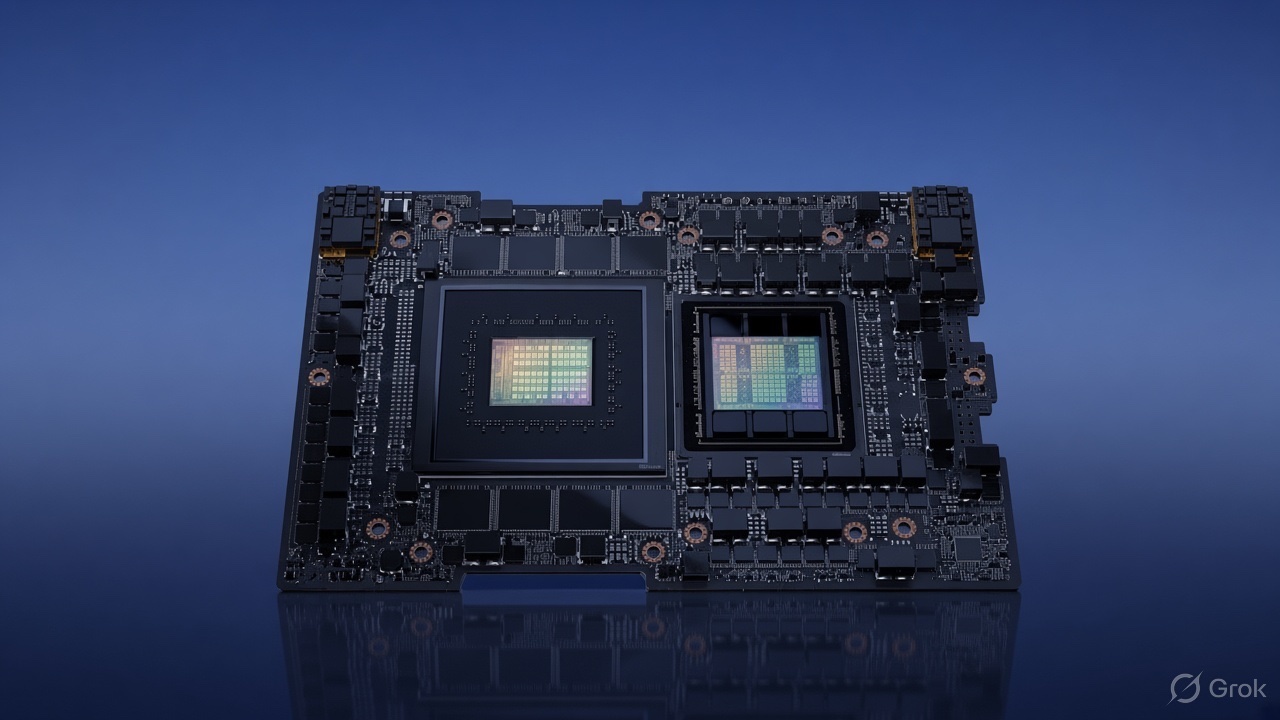
Microsoft’s Maia 300 highlights the growing threat of custom AI chips to NVIDIA’s share of inference computing, while China’s CXMT advances a denser 4F² DRAM architecture that could pressure conventional memory pricing. However, DRAM and HBM face different competitive risks. The key question is who captures AI’s profits as competition rises and hyperscalers optimize infrastructure spending.
📅 October 14, 2026
📝 EXECUTIVE SUMMARY
The semiconductor sell-off is exposing three distinct risks: hyperscalers developing their own AI chips, China challenging conventional DRAM manufacturing economics, and investors questioning whether AI infrastructure spending can generate sustainable returns.
The most important connection is Microsoft's position on both sides of the AI chip market. Microsoft is a major NVIDIA customer while simultaneously developing its own AI accelerators. Meanwhile, Chinese memory manufacturer CXMT is pursuing a separate challenge to conventional DRAM production.
These developments should not be confused with evidence that AI demand is collapsing or that Chinese manufacturers have already caught up in high-bandwidth memory (HBM).
🔹 Microsoft Maia 300: A potential challenge to NVIDIA's share of selected AI inference workloads.
🔹 China's CXMT 4F² DRAM: A potential long-term threat to conventional DRAM pricing power if the new architecture reaches commercial scale.
🔹 HBM: A separate market with more demanding stacking, packaging, bandwidth and qualification requirements.
🔹 AI capital expenditure: A broader risk if spending grows faster than the revenue and productivity gains generated by AI.
🎯 Core thesis: The market is not necessarily saying AI demand is disappearing. It is questioning who will capture the profits as competition increases.
🔵 1. MICROSOFT MAIA 300: THE NVIDIA COMPETITION STORY
Microsoft announced its third-generation Maia accelerator, Maia 300, on October 12, 2026. The chip is designed primarily for AI inference, including long-context reasoning, conversational AI and multi-step agentic workloads.
Microsoft expects deployments to begin in 2027 as it expands its custom-chip infrastructure. The announcement is important because Microsoft is one of NVIDIA's major customers and is simultaneously building an alternative for selected workloads.
📌 Official announcement: https://blogs.microsoft.com/blog/2026/10/12/microsoft-to-expand-azure-maia-system-to-multi-gigawatt-deployments/
💰 Microsoft Is Both a Major NVIDIA Customer and a Potential Competitor
Microsoft has invested heavily in NVIDIA-powered infrastructure to expand Azure's AI capacity and support AI services, including workloads associated with OpenAI.
According to Omdia estimates reported by Fortune in December 2024, Microsoft purchased approximately 485,000 NVIDIA Hopper accelerators during 2024, making it the largest buyer in that particular industry estimate.
Important qualification: This is a historical estimate, not an NVIDIA-confirmed customer total or proof that Microsoft remains NVIDIA's largest buyer in October 2026.
📌 Historical reporting: https://fortune.com/2024/12/19/microsoft-biggest-mystery-whales-buying-up-nvidia-hopper-ai-chips/
This creates a strategic paradox.
Microsoft has helped drive demand for NVIDIA hardware while investing in its own silicon to reduce the cost of operating AI infrastructure.
Why does this matter?
• 💰 Customer concentration: A relatively small number of hyperscalers account for substantial AI infrastructure spending.
• 🧠 Vertical integration: Microsoft can increasingly choose between NVIDIA GPUs and its own accelerators for suitable workloads.
• 📉 Pricing power: An internal alternative strengthens Microsoft's negotiating position, even if it continues purchasing NVIDIA hardware.
• 🚀 Market share: NVIDIA's revenue could continue growing while its share of incremental inference spending declines.
⚙️ What Makes Maia 300 Important?
Microsoft has reported the following Maia 300 specifications:
• HBM configuration: Eight HBM4 stacks.
• Memory capacity: 288 GB per accelerator.
• Peak memory bandwidth: 18 TB/s.
• Accelerators per rack: 96.
• Rack power envelope: 167 kW.
• Claimed efficiency: 40% more tokens per megawatt than leading GPU-based systems.
• Expected deployment: Beginning in 2027.
These are manufacturer-reported specifications and performance claims. The efficiency advantage requires independent verification across comparable workloads after deployment.
🧠 Why Inference Is the Battleground
AI computing has two major stages.
Training develops a model by adjusting its parameters using large datasets. It requires substantial parallel computing resources.
Inference uses a trained model to answer questions, generate code, summarize information and execute tasks. As AI adoption expands, inference becomes a recurring operating expense.
For a cloud provider serving millions of users, even relatively small efficiency improvements can translate into significant savings.
Microsoft wants to optimize the cost of delivering each useful AI response, rather than relying entirely on third-party accelerators.
However, the real comparison must include more than theoretical chip performance. Software maturity, memory bandwidth, networking, power, cooling, latency and utilization all affect the economics.
📉 Does Maia 300 Threaten NVIDIA?
The answer is nuanced.
1️⃣ Workload substitution: Microsoft could route suitable inference workloads to Maia instead of purchasing additional NVIDIA accelerators for those workloads.
2️⃣ Negotiating leverage: Maia gives Microsoft a credible alternative when negotiating hardware prices, supply commitments and infrastructure costs.
3️⃣ Changing growth expectations: Investors may begin discounting NVIDIA's future market share before any material decline appears in reported revenue.
But Maia is not a universal replacement for NVIDIA GPUs. Training, flexible cloud computing and workloads requiring NVIDIA's mature software ecosystem may continue to depend heavily on its hardware.
Furthermore, Microsoft can expand its overall AI capacity while using both NVIDIA and Maia systems.
DeltaNode assessment: Maia 300 is a potential challenge to NVIDIA's share of selected workloads and future pricing power. It is not, by itself, evidence that NVIDIA's business is in structural decline.
🇨🇳 2. CHINA'S CXMT: THE 4F² DRAM BREAKTHROUGH
The second development is technically different from Microsoft's AI accelerator programme.
ChangXin Memory Technologies, or CXMT, is China's leading DRAM manufacturer. Reports published on October 12, 2026, described progress on a denser 4F² DRAM architecture and plans to introduce server DDR5 registered DIMM products using the technology.
The commercial competitiveness and production scale of the new architecture still require verification.
📌 Industry reporting: https://www.trendforce.com/news/2026/10/12/news-cxmt-accelerates-4f%C2%B2-dram-push-eyes-year-end-server-ddr5-rdimm-launch/
🔬 What Is 4F² DRAM?
DRAM stores data in memory cells built around a transistor and a capacitor.
The symbol F represents a characteristic minimum feature dimension used to describe the cell architecture.
A conventional 6F² cell occupies an idealized area proportional to 6F². A 4F² design targets an area proportional to 4F².
The theoretical reduction in cell area is:
(6 − 4) ÷ 6 × 100 = 33.3%
Under simplified assumptions, a 4F² architecture could fit approximately 50% more memory cells into the same cell-array area than a 6F² design.
This is a theoretical geometric comparison, not a guarantee of 50% more finished-chip capacity or 33% lower manufacturing costs.
Peripheral circuits, manufacturing yields, redundancy, reliability and process complexity all affect the final outcome.
💡 Why CXMT's Development Matters
If CXMT can manufacture the architecture reliably and at commercial scale, it could potentially:
• Increase memory density per unit of cell-array area.
• Improve manufacturing economics.
• Expand its position in server memory.
• Increase domestic memory supply for Chinese technology companies.
• Create additional pricing pressure for established international DRAM manufacturers.
The critical question is whether CXMT can turn a promising architecture into reliable, high-yield production.
🏭 The Manufacturing Hurdles
A new memory architecture must clear several stages before it materially affects the global market.
-
Design feasibility: Can the memory cells operate as intended?
-
Yield: Can the manufacturer produce a sufficiently high proportion of functioning chips?
-
Reliability: Can the memory operate continuously under demanding workloads?
-
Customer qualification: Can server manufacturers validate the memory modules?
-
Production scale: Can output grow enough to affect global supply and prices?
A technology announcement is not equivalent to mass production, and mass production is not automatically equivalent to competitive profitability.
📊 Is CXMT Already a Competitive Threat?
TrendForce reported that CXMT's share of global DRAM revenue rose to approximately 9.5% in the second quarter of 2026, from 7.6% in the previous quarter.
That suggests CXMT's expansion is already relevant to the conventional memory market, even before the commercial impact of its reported 4F² architecture is established.
Investors do not need to wait for a new competitor to capture substantial market share before repricing incumbent manufacturers. Expectations of future supply growth can put pressure on valuations today.
DeltaNode assessment: CXMT represents a credible longer-term threat to conventional DRAM economics. The scale of that threat depends on production yields, capacity, product reliability, customer adoption and competing manufacturers' technology roadmaps.
⚙️ 3. DRAM VS HBM: THE CRITICAL DISTINCTION
One of the biggest analytical mistakes in the current semiconductor debate is treating all memory as interchangeable.
Conventional DRAM and high-bandwidth memory share underlying technology, but their product engineering and competitive dynamics differ substantially.
📊 Conventional DRAM
Conventional DRAM is used in PCs, smartphones and servers.
Its economics depend heavily on cost per bit, memory density, manufacturing yields, reliability and supply-demand balance.
CXMT's reported 4F² development is directly relevant to this market because a successful architecture could potentially improve density and manufacturing economics.
🚀 High-Bandwidth Memory (HBM)
HBM is designed to provide extremely high bandwidth for AI accelerators and high-performance computing systems.
It stacks multiple DRAM dies vertically and connects them using dense interconnects, commonly through-silicon vias. HBM packages sit close to the processor to provide high data throughput with relatively efficient access to memory.
Competing in HBM requires much more than manufacturing a dense DRAM cell.
Suppliers must demonstrate:
• High-quality DRAM dies suitable for stacking.
• Reliable vertical interconnects.
• Advanced packaging and integration.
• Thermal and power management.
• High bandwidth with acceptable production yields.
• Successful qualification with accelerator designers and customers.
🇨🇳 Could CXMT's 4F² Technology Eventually Affect HBM?
Potentially, but this remains a future possibility.
If CXMT successfully commercializes its new architecture, it could eventually explore adapting it for HBM-compatible products. That would require additional development, integration and customer qualification.
Conventional server DDR5 success does not prove that a company can compete in advanced HBM.
The near-term conclusion is clear:
CXMT's reported 4F² progress is a direct conventional DRAM concern. It is not proof that China has caught up with SK Hynix, Micron or Samsung in advanced HBM.
📉 4. WHY MEMORY STOCKS ARE FALLING TOGETHER
The sell-off in memory-related stocks reflects overlapping concerns about competition, future pricing and the sustainability of AI investment.
However, these risks do not affect every company in the same way.
💻 Micron Technology (NASDAQ: MU)
Micron is exposed to conventional DRAM, NAND and HBM.
CXMT's progress raises questions about conventional DRAM competition. Separately, Micron's HBM business is influenced by AI demand, product execution, customer qualification and manufacturing capacity.
A decline in Micron's share price does not establish that its HBM business is losing its competitive position.
🧠 SK Hynix
SK Hynix is a major supplier of HBM used in AI infrastructure, alongside its conventional DRAM business.
Its conventional memory business can face pressure from additional DRAM supply, while its HBM prospects depend on product generations, qualification, yields and production execution.
The two businesses must be assessed separately.
🏭 Samsung Electronics
Samsung competes across conventional DRAM, HBM, NAND and other semiconductor markets.
CXMT's expansion could pressure expectations for standard memory. Samsung's HBM position depends on additional factors, including product competitiveness, qualification and manufacturing execution.
📌 What Does the Share-Price Reaction Actually Tell Us?
There are four distinct stages in the impact of a new technology.
1️⃣ Technology announcement: A new architecture is developed or prepared for launch.
2️⃣ Commercial validation: Customers qualify the product and performance is demonstrated.
3️⃣ Production impact: Meaningful volumes reach the market.
4️⃣ Financial impact: Revenue, pricing or margins change enough to affect incumbent earnings.
Stock prices can react at the first stage, while the actual financial consequences may take much longer to establish.
The current market concern is therefore about future expectations, not proof that every memory producer is already experiencing deteriorating fundamentals.
💰 5. THE THIRD RISK: AI CAPITAL EXPENDITURE AND RETURN ON INVESTMENT
The semiconductor story cannot be understood through chips and memory alone.
Cloud providers are spending enormous amounts on data centres, accelerators, networking, power infrastructure and cooling. Investors increasingly need evidence that these investments will generate sufficient revenue or strategic value.
The economic chain is straightforward:
-
Cloud providers invest in AI infrastructure.
-
AI services must generate sufficient revenue, productivity gains or strategic value to justify the investment.
-
If utilization or monetization disappoints, providers may optimize existing capacity before adding more.
-
Slower purchasing or more aggressive cost optimization can affect suppliers across the AI infrastructure chain.
Reuters reported that Microsoft expected to spend more than $175 billion in capital expenditure during calendar 2026. That figure illustrates the scale of the infrastructure buildout, but it does not guarantee future semiconductor purchases or prove that every investment will earn an attractive return.
Why Custom Chips Fit This Trend
A custom accelerator can allow a cloud provider to optimize a workload for its own software and infrastructure.
If it delivers the required performance at a lower total cost, it can improve the economics of the entire service.
But lower costs do not automatically reduce total AI spending. More efficient computing can also make previously expensive workloads economically viable, potentially increasing demand.
The outcome depends on whether efficiency gains produce more demand, lower total expenditure or a combination of both.
The key distinction is between continued investment in AI and continued growth in supplier profitability.
AI demand can grow while individual semiconductor companies experience margin pressure or valuation compression.
🔍 6. THE MICROSOFT PARADOX: A CUSTOMER THAT CAN ALSO THREATEN MARGINS
Microsoft's role brings the entire story together.
As a major NVIDIA customer, Microsoft has helped drive demand for AI infrastructure. As a cloud provider, it also has a strong incentive to lower inference costs and optimize the returns on its data-centre investments.
Maia 300 is part of that strategy.
Three outcomes are possible.
🟢 Outcome A: Complementary Expansion
Maia handles additional workloads that would not otherwise have justified NVIDIA hardware. Microsoft's total AI capacity grows, and NVIDIA's absolute sales can continue increasing.
🟡 Outcome B: Partial Substitution
Maia replaces some planned NVIDIA purchases for suitable inference workloads. Microsoft's infrastructure continues growing, but NVIDIA captures a smaller share of incremental spending than it otherwise would have.
🔴 Outcome C: Greater Customer Leverage
Even if NVIDIA remains essential, Microsoft's internal alternative improves its negotiating position and increases pressure on suppliers to demonstrate measurable performance and cost advantages.
These outcomes are not mutually exclusive. Microsoft could expand total AI capacity, substitute some workloads and gain negotiating leverage at the same time.
The critical question is not simply whether Maia succeeds.
It is how Maia changes the mix of Microsoft's future infrastructure spending.
📈 7. THREE SCENARIOS FOR THE SEMICONDUCTOR TRADE
These are analytical scenarios, not price targets or probability-weighted forecasts.
🟢 Scenario A: AI Demand Remains Strong
• Maia expands Microsoft's inference capacity without materially reducing NVIDIA's overall demand.
• CXMT struggles to achieve competitive yields or meaningful server-memory production in the near term.
• HBM demand remains strong as AI infrastructure expands.
• Earnings and guidance support semiconductor valuations.
What to monitor: Strong forward guidance, sustained HBM demand, stable conventional DRAM pricing and evidence that AI investment is generating growing workloads.
🟡 Scenario B: Competition Increases
• Custom accelerators capture a larger share of hyperscaler inference workloads.
• CXMT gradually expands conventional DRAM supply.
• Memory suppliers face greater pricing pressure and more uneven margins.
• Semiconductor revenue continues growing, but investors become more selective about valuations.
What to monitor: Internal-chip deployments, conventional DRAM capacity growth, product-level pricing and divergence between HBM results and standard-memory economics.
🔴 Scenario C: Spending and Pricing Power Weaken
• AI monetization fails to keep pace with infrastructure investment.
• Hyperscalers slow new capacity commitments or prioritize utilization of existing systems.
• Conventional memory supply grows faster than demand can absorb.
• Earnings expectations decline, increasing the risk of further semiconductor valuation compression.
What to monitor: Weaker capital expenditure guidance, delayed orders, declining memory contract prices, reduced HBM growth expectations and deteriorating supplier margins.
📊 8. DELTANODE MONITORING FRAMEWORK
The strongest way to evaluate this thesis is to monitor operating indicators that can confirm or invalidate the current market narrative.
NVIDIA
Monitor data-centre revenue, forward guidance, gross margin and customer demand.
Signal: Tests whether GPU demand and pricing power remain durable.
Microsoft
Monitor Maia deployments, Azure growth, AI monetization and infrastructure efficiency.
Signal: Tests whether custom silicon gains meaningful adoption and improves Microsoft's return on investment.
Micron
Monitor DRAM and HBM revenue, contract pricing, inventories and margins.
Signal: Separates conventional memory pressure from AI-memory growth.
SK Hynix
Monitor HBM product execution, customer qualification, capacity and yields.
Signal: Tests the durability of its HBM competitive position.
Samsung
Monitor HBM qualification, DRAM pricing and manufacturing yields.
Signal: Tests execution across its memory portfolio.
CXMT
Monitor actual production, yields, server DDR5 adoption and manufacturing capacity.
Signal: Tests whether its reported technology advances become meaningful additional supply.
Hyperscalers
Monitor capital expenditure guidance, utilization, AI revenue growth and cash generation.
Signal: Tests the sustainability of AI infrastructure spending.
Memory Pricing
Monitor contract prices and inventory trends separately for conventional DRAM, HBM and NAND.
Signal: Helps identify where supply is outpacing demand rather than treating the entire memory market as one segment.
The strongest evidence will come from the relationship between production, pricing, customer demand and company guidance, not from a single technology announcement or stock-price move.
🎯 9. FINAL ASSESSMENT: WHAT THE MARKET IS REALLY REPRICING
The semiconductor sell-off contains three separate investment questions.
First: Who captures the economics of AI computing?
Microsoft's Maia programme demonstrates that major cloud providers want greater control over inference costs and performance. This creates a potential challenge to NVIDIA's share of selected workloads, but it does not establish that GPU demand is collapsing.
Second: Who retains pricing power in conventional memory?
CXMT's 4F² development could become important if it translates into reliable, high-yield production at commercial scale. Its significance today is the possibility of future competition, not proof of immediate technological dominance.
Third: Can HBM suppliers preserve their competitive advantages?
HBM remains a distinct market with demanding packaging, integration and qualification requirements. Conventional DRAM competition should not be treated as an immediate substitute for HBM-specific analysis.
The strongest conclusion is that investors should stop treating GPUs, conventional DRAM and HBM as one undifferentiated semiconductor trade.
A company can benefit from continued AI growth while facing margin pressure. A memory manufacturer can experience conventional DRAM pricing risks while benefiting from HBM demand. A hyperscaler can reduce its cost per token while continuing to increase total AI infrastructure spending.
The next phase of the AI trade will be determined by pricing power, production execution, efficiency and returns on capital, not by AI demand alone.
ΔΣΦ | DELTANODE MARKET INTELLIGENCE
📚 SOURCES & FURTHER READING
-
Microsoft: Maia 300 announcement and Azure infrastructure strategy
https://blogs.microsoft.com/blog/2026/10/12/microsoft-to-expand-azure-maia-system-to-multi-gigawatt-deployments/ -
Reuters: Microsoft's custom AI chip deployment strategy
https://www.reuters.com/business/microsoft-plans-huge-deployment-its-own-ai-chips-with-an-eye-saving-costs-2026-10-12/ -
Fortune: Historical estimates of Microsoft's NVIDIA accelerator purchases
https://fortune.com/2024/12/19/microsoft-biggest-mystery-whales-buying-up-nvidia-hopper-ai-chips/ -
TrendForce: CXMT's 4F² DRAM development and server DDR5 plans
https://www.trendforce.com/news/2026/10/12/news-cxmt-accelerates-4f%C2%B2-dram-push-eyes-year-end-server-ddr5-rdimm-launch/ -
Investopedia: Memory-stock reaction to China's reported DRAM progress
https://www.investopedia.com/market-update-memory-stocks-extend-slide-on-news-of-design-breakthrough-in-china-12171774 -
NVIDIA: Fiscal 2026 annual filing and customer concentration disclosures
https://www.sec.gov/Archives/edgar/data/1045810/000104581026000021/nvda-20260125.htm
⚠️ Research Limitations
Microsoft's Maia performance figures are company-reported. Microsoft's historical position as NVIDIA's largest buyer is based on industry estimates reported in 2024, not a verified October 2026 ranking. CXMT's reported 4F² development does not establish mass-production yields or competitive HBM capability. Forward-looking scenarios are analytical frameworks, not forecasts or investment recommendations.