Market Report ·
🌐 DeltaNode Weekly Macro & Market Intelligence ## October 12–16, 2026 | The Week Ahead
**Theme: Inflation, Energy Shock & Earnings Under Pressure**
The coming week puts the US inflation outlook, Federal Reserve policy, energy-driven price pressures, and third-quarter corporate earnings at the center of the market. With Treasury yields elevated, oil prices above $100, and geopolitical risks surrounding the Strait of Hormuz, investors face a difficult combination: resilient equity markets alongside growing inflationary pressure.
The key question is whether inflation data will reinforce the case for further Fed tightening or give markets room to extend their rally.
📊 1. Last Week: What Moved the Market?
🏦 Federal Reserve: Rate Hikes Back on the Table
The September FOMC minutes revealed that many participants considered another increase in the federal funds target range likely to be appropriate by year-end.
Officials also noted that financial conditions remained supportive of economic growth despite rising longer-term Treasury yields.
- 10-year Treasury yield: Reached above 5.35% before ending the week at 5.24%.
- Weekly change: Down 4 basis points.
- Policy implication: The prospect of further tightening remains alive.
DeltaNode interpretation: Markets must now balance growth resilience against the risk of persistently restrictive monetary policy. A stronger-than-expected CPI print could push yields higher, strengthen the dollar, and pressure risk assets. A softer reading could ease financial conditions and support equities and crypto.
📈 US Services: Growth Holds, Inflation Pressure Builds
September ISM Services PMI came in at 54.9, compared with 55.4 in August and expectations of 55.2.
The headline suggests continued expansion, but the internal components deserve closer attention:
- Prices index: 74.0, up from 72.6 and the highest since July 2022.
- Employment index: 50.1, recovering from 47.8 and returning above the expansion/contraction threshold.
Market implication: The services sector remains active while input-price pressures intensify. This complicates the Fed's task because economic resilience and persistent inflation can limit its ability to ease policy.
✈️ Delta Air Lines: Fuel Costs Hit Earnings
Delta Air Lines reported adjusted third-quarter earnings of $1.72 per share, below published forecasts of $1.81–$1.92.
The company reduced its full-year adjusted earnings guidance to $5.10–$5.60 per share from $6.50–$7.50, citing a $6 billion increase in fuel costs. Its reported fuel price averaged $3.61 per gallon, up 60%.
DeltaNode interpretation: Energy shocks do not affect every sector equally. Airlines face direct margin pressure, while higher fuel and transportation costs can eventually feed into broader consumer prices and corporate expenses.
🧾 University of Michigan: Consumer Confidence Weakens
Preliminary October consumer sentiment fell to 46.3, down from 48.1 in September and below expectations of 47.8.
Inflation expectations also increased:
- One-year inflation expectation: 4.7%.
- Five-year inflation expectation: 3.5%.
Both rose by 0.1 percentage points.
Market implication: Weak sentiment alongside rising inflation expectations creates a difficult macroeconomic combination. Consumers may become more cautious even as businesses continue to face elevated costs.
📉 Equities Rally Despite Macro Risks
The S&P 500 reached a new record for the first time since mid-August and closed Friday at 7,811.54, gaining 1.2% for the week.
The rally suggests that equity investors have not fully priced in the possibility of renewed Fed tightening or a prolonged energy shock.
The disconnect matters: strong price action is not, by itself, confirmation that the underlying macro risks have disappeared.
🌍 2. The Macro Setup: Three Forces to Watch
🛢️ Energy Supply and Geopolitics
Brent crude settled at $104.72 amid disruptions to energy supply and elevated geopolitical risk.
The supplied reports also describe a closure of the Strait of Hormuz and reduced Gulf of Mexico oil output following Hurricane Isaias.
These developments create two potential inflation channels:
- Direct impact: Higher fuel, freight, and energy costs.
- Second-order impact: Higher operating costs that businesses may pass on to consumers.
If elevated energy prices persist, inflation could remain sticky even as consumer demand weakens.
🏦 Monetary Policy and Treasury Yields
The Fed's policy outlook remains sensitive to incoming inflation and labor-market data.
Watch the interaction between:
- US CPI and inflation expectations.
- The 10-year Treasury yield.
- The US Dollar Index (DXY).
- Market-implied expectations for future Fed policy.
A hotter CPI print combined with rising yields and a stronger dollar would indicate tighter financial conditions. A softer print accompanied by falling yields and a weaker dollar could support risk assets.
₿ Bitcoin and Liquidity Conditions
Bitcoin's response should be assessed through liquidity and positioning rather than macro headlines alone.
Key indicators for DeltaNode to monitor:
- DXY: Is dollar strength increasing or fading?
- US 10-year yield: Are real and nominal yields moving higher?
- BTC spot flows: Is genuine spot demand supporting price?
- Open interest (OI): Are new positions building or existing positions unwinding?
- Cumulative volume delta (CVD): Is aggressive buying or selling dominating?
- Funding rates: Are leveraged longs or shorts becoming crowded?
Interpretation framework:
🟢 Softer CPI + falling yields + weaker DXY + positive spot demand could support a bullish risk-asset setup.
🔴 Hotter CPI + rising yields + stronger DXY + negative spot flows could create bearish pressure.
🟠 Mixed macro signals or conflicting derivatives data call for patience rather than a forced directional trade.
These are conditional scenarios, not trading signals. Confirmation from price action and market positioning remains essential.
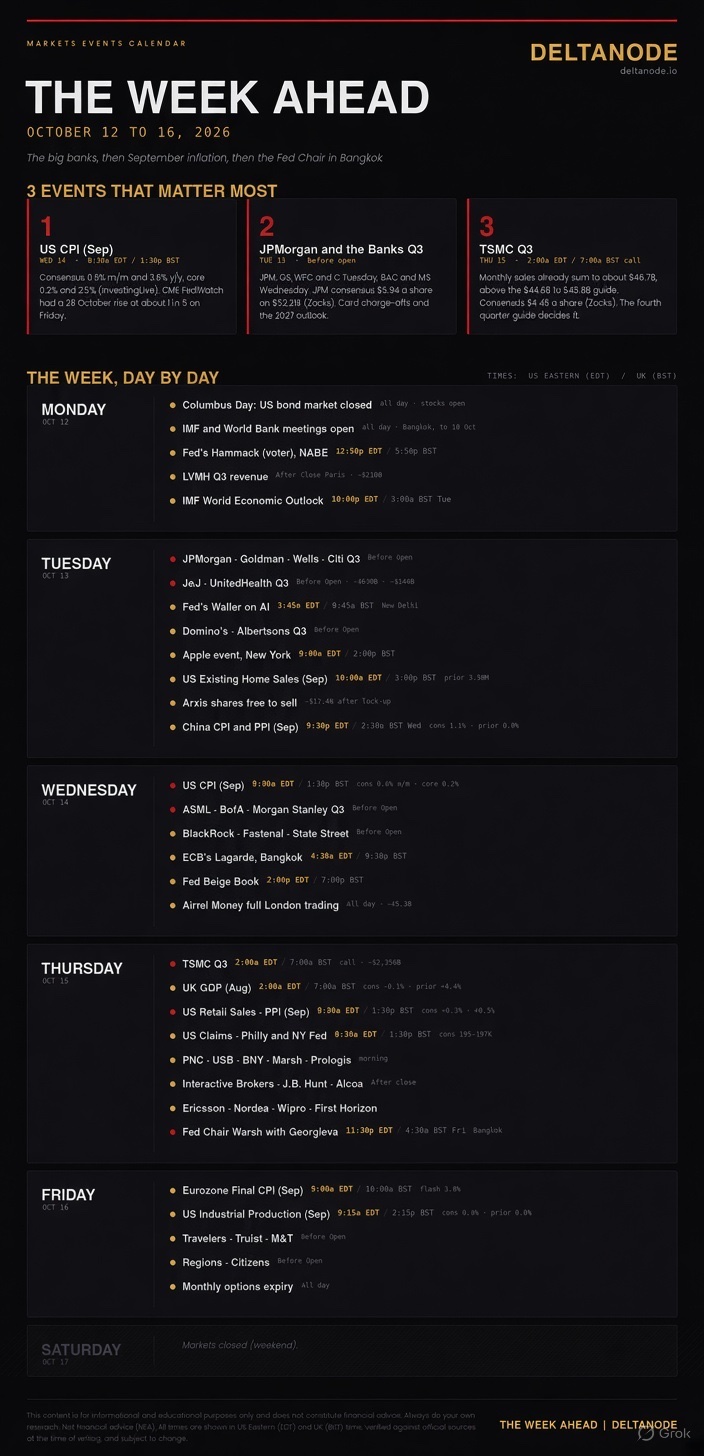
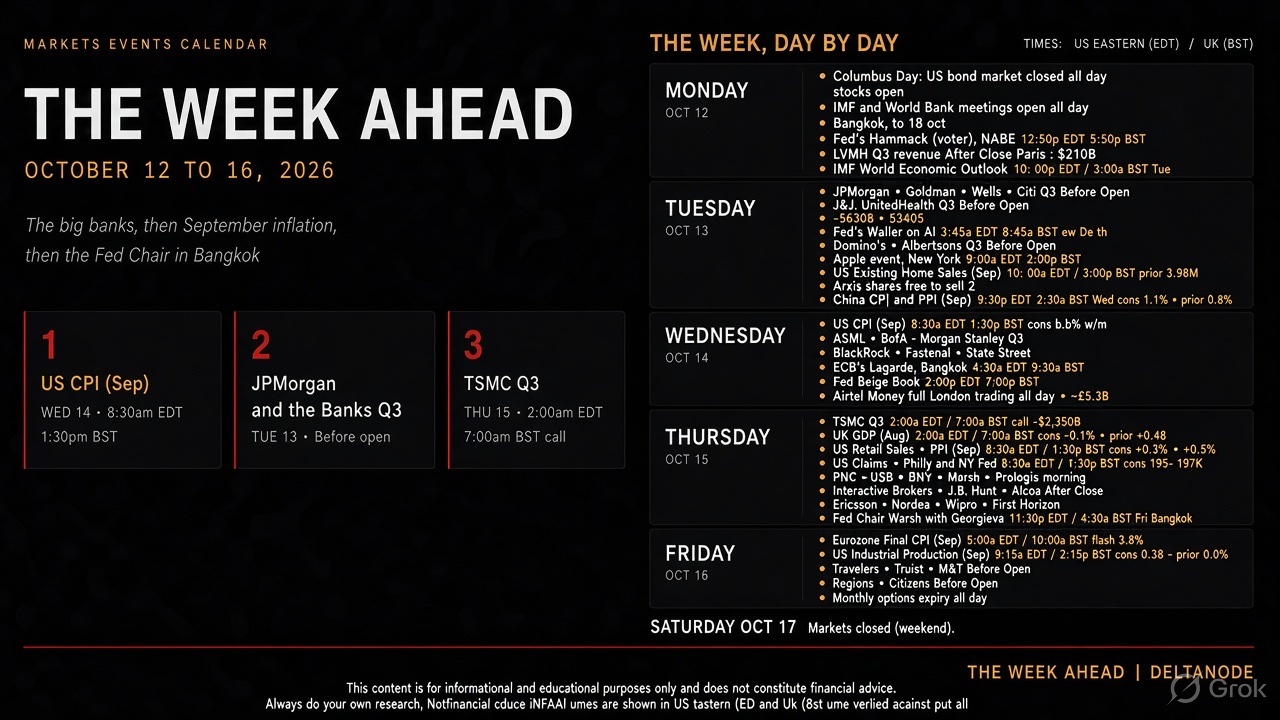
📅 3. Week Ahead: Critical Events
Times below are reproduced from the supplied schedule. Verify official releases and event times before publication or trading.
🔴 Tuesday, October 13
Before the US market opens
- JPMorgan Q3 earnings.
- Goldman Sachs Q3 earnings.
- Wells Fargo Q3 earnings.
- Citigroup Q3 earnings.
9:00 AM ET / 2:00 PM BST
- Apple event in New York.
Why it matters: Major-bank earnings can reveal credit conditions, consumer resilience, trading activity, and management expectations. Apple is a separate technology-sector catalyst that could influence sentiment toward large-cap growth stocks.
🔴 Wednesday, October 14
8:30 AM ET / 1:30 PM BST
- US Consumer Price Index (September).
Before the US market opens
- Bank of America Q3 earnings.
- Morgan Stanley Q3 earnings.
- ASML Q3 earnings.
2:00 PM ET / 7:00 PM BST
- Federal Reserve Beige Book.
Why it matters: CPI is the week's primary macro catalyst. Bank results will provide further insight into the financial system, while ASML's outlook may influence semiconductor and AI-related sentiment.
🔴 Thursday, October 15
2:00 AM ET / 7:00 AM BST
- UK GDP (August).
8:30 AM ET / 1:30 PM BST
- US Retail Sales (September).
- US Producer Price Index (September).
2:00 AM ET / 7:00 AM BST
- TSMC Q3 results, as listed in the supplied schedule.
11:30 PM ET / Friday, 4:30 AM BST
- Fed Chair Kevin Warsh with IMF Managing Director Kristalina Georgieva, as listed in the supplied schedule.
Why it matters: Retail Sales will help assess consumer demand, while PPI provides another view of pipeline inflation. TSMC's results and guidance could affect sentiment across semiconductors, AI infrastructure, and the broader technology sector.
Note: The TSMC and UK GDP times above are reproduced from the source material and should be checked against official schedules.
🎯 4. DeltaNode's Market Watchlist
| Indicator | Bullish implication | Bearish implication |
|---|---|---|
| US CPI | Below expectations, with easing underlying inflation | Above expectations, with persistent price pressure |
| US 10-year yield | Falling yields | Renewed rise toward or beyond recent highs |
| DXY | Weakening dollar | Broad dollar strength |
| Brent crude | Sustained decline in energy prices | Further supply-driven price increases |
| US Retail Sales | Resilient demand without renewed inflation pressure | Weak demand, or strong demand that reinforces inflation |
| BTC spot flows | Sustained net buying | Persistent spot selling |
| BTC OI and CVD | Price supported by genuine demand | Rising OI alongside negative CVD may indicate vulnerable positioning |
| Funding | Moderate positioning without excessive leverage | Crowded longs or shorts vulnerable to liquidation |
No single indicator should determine the market view. The objective is to identify whether macro conditions, spot demand, and derivatives positioning are confirming the same direction.
🧠 5. Scenario Analysis: What Could Happen Next?
Scenario A: Inflation Cools
If CPI comes in below expectations and Treasury yields retreat, markets could interpret the data as evidence that inflation pressure is easing.
Potential beneficiaries: Growth stocks, technology, and crypto, provided the dollar weakens and liquidity conditions improve.
Confirmation required: Falling yields, softer DXY, improving spot demand, and constructive price structure.
Scenario B: Inflation Reaccelerates
If CPI surprises higher, markets may reassess the likelihood of further Fed tightening.
Potential pressure points: Long-duration equities, leveraged crypto positions, and assets sensitive to higher discount rates.
Confirmation required: Rising yields, stronger DXY, deteriorating spot flows, and price rejection at resistance.
Scenario C: Mixed Data, No Clear Direction
If inflation cools but consumer demand weakens sharply, or if headline inflation falls while underlying price pressure remains elevated, markets may struggle to establish a durable trend.
DeltaNode response: Reduce conviction, wait for confirmation, and avoid forcing trades during conflicting signals.
⚠️ 6. Key Risks
- Inflation risk: Higher energy costs could keep inflation expectations elevated.
- Policy risk: Additional Fed tightening could tighten financial conditions.
- Geopolitical risk: Disruptions around the Strait of Hormuz could sustain an energy risk premium.
- Earnings risk: Fuel costs and weaker consumer sentiment could pressure forward guidance.
- Positioning risk: Crowded leveraged positions can amplify moves around major data releases.
- Event risk: CPI, PPI, Retail Sales, and major earnings can trigger volatility, slippage, and rapid changes in market structure.
🔎 DeltaNode Closing View
The market enters the week with a notable divergence: equities are reaching records, but inflation expectations remain elevated, energy prices are high, and the Federal Reserve has not ruled out additional tightening.
The central question is whether market strength can withstand a renewed inflation shock.
For Bitcoin and broader risk assets, the answer will depend on more than the CPI headline. Treasury yields, the dollar, spot flows, open interest, CVD, and funding must be evaluated together.
DeltaNode will focus on the evidence as it develops, distinguish confirmed data from reported claims, and avoid assigning directional conviction before the signals align.
Price the market every day. Follow the data, not the noise.
Δ Σ Φ | DeltaNode Research
Disclaimer: This report is for informational and research purposes only. It is not financial advice or a recommendation to buy or sell any asset.